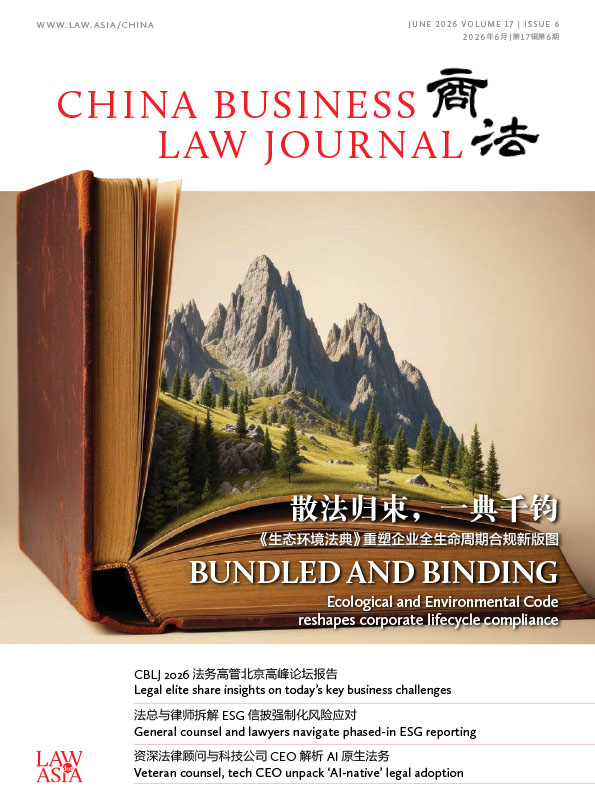





As China phases in mandatory ESG reporting, the challenge for companies is whether to showcase “green” or prove it. Pan Xinyi reports
“THIS ISN’T JUST DATA; it’s our entire operation core,” confessed the head of legal at a manufacturing firm while reviewing supply-chain environmental and social governance (ESG) compliance. Across conference room tables, Supplier Code of Conduct agreements are being pushed back. They demand the disclosure of highly sensitive metrics, energy usage, carbon emissions, hazardous waste disposal and labour rights, alongside the underlying calculation methodologies. It is a scene playing out in an increasing number of corporate procurement negotiations.
Multiple forces are driving this shift. Following the continual tightening of ESG rules by the Hong Kong Stock Exchange, the official implementation of the EU’s Carbon Border Adjustment Mechanism (CBAM), and escalating supply chain entry and due diligence requirements from international clients, domestic regulation has advanced at an unprecedented pace in the past two years.
In April 2024, China’s three major stock exchanges issued the Guidelines on Sustainability Reporting for Listed Companies. This was followed by the first batch of Preparation Guides in January 2025. By January 2026, the revised Code of Corporate Governance for Listed Companies officially took effect, coinciding with the Ministry of Finance’s rollout of the Sustainable Information Assurance Standard No.6101. Subsequently, the exchanges released revised preparation guides, adding three specific modules covering pollutant emissions, energy utilisation and water resource management.
Under the guidelines 487 companies, primarily constituents of core indices and dual-listed A+H companies, were required to publish their sustainability reports (also known as ESG reports) by 30 April 2026. As of that deadline, 430 of these mandatory disclosers had released their reports, officially cementing 2026 as the inaugural year of mandatory ESG disclosure for the A-share market.
This signifies that ESG disclosure has shifted from a voluntary initiative into the crosshairs of securities law and cross-border compliance. Terms like “green”, “low-carbon” and “net zero” are no longer buzzwords for corporate communications teams.
The risks of ESG disclosure go beyond merely “whether the claims are true”. A vast amount of ESG data relies on estimates, indirect greenhouse gas emissions across the upstream and downstream value chain are difficult to assess, and forward-looking commitments are uncertain.
As the regulatory framework takes shape and companies hand in their first reports, where should their focus lie? And how can they prove that their disclosures are built on verifiable procedures backed by a fully documented audit trail?
Liability reshuffle
A documented procedural trail requires clear individual accountability. Behind the trend of mandatory A-share ESG disclosure lies a fundamental reallocation of internal liability. The evolving role of the legal department is particularly striking. “Legal teams have transitioned from traditional back-end compliance reviews and wordsmithing to front-end architecture designers and rule-makers,” says Xie Chenyang, vice president and chief legal officer at Foxconn Industrial Internet (FII).
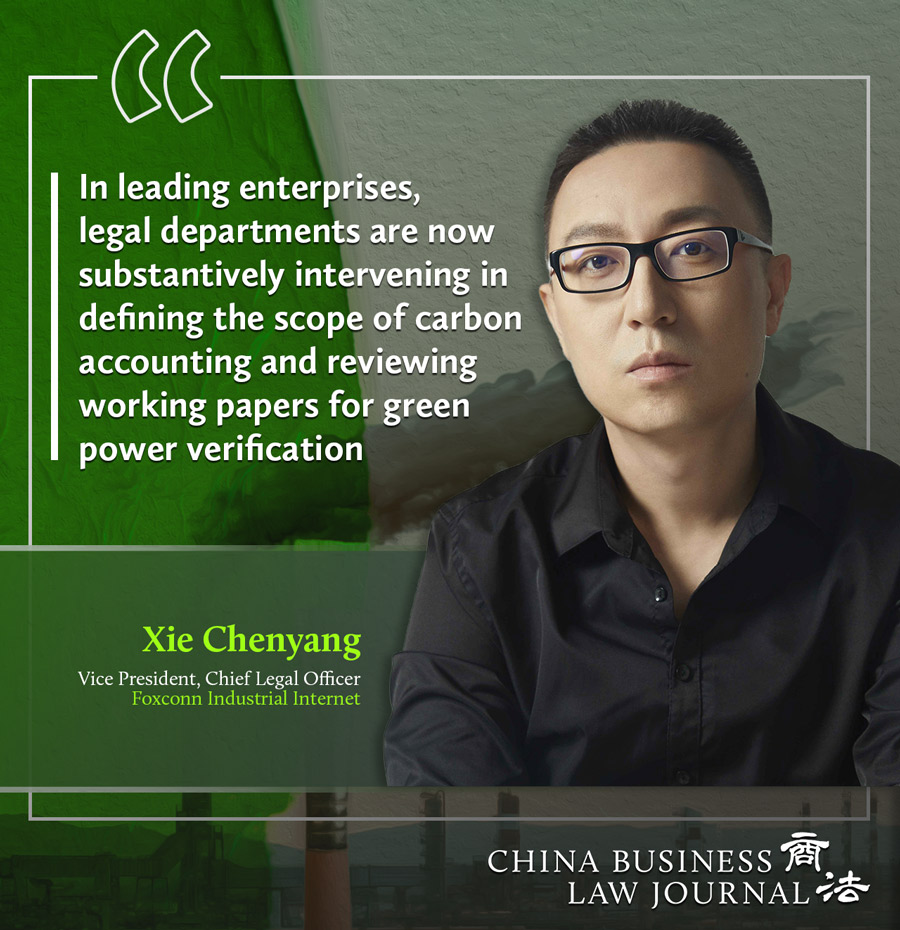
“In leading enterprises, legal departments are now substantively intervening in defining the scope of carbon accounting and reviewing working papers for green power verification. They are also building due diligence defence processes to protect directors and senior executives when they sign off on reports,” says Xie.
Moving to the frontlines also demands an upgrade in capabilities. The general counsel of one multinational industrial group says: “In-house counsel must now understand different ESG metrics and statistical methodologies – such as: the Global Reporting Initiative (GRI); the Sustainability Accounting Standards Board (SASB) Standards; and the Task Force on Climate-related Financial Disclosures (TCFD) Framework – and grasp the nuances between them. This requires legal to possess some financial literacy, which was never the case before.”
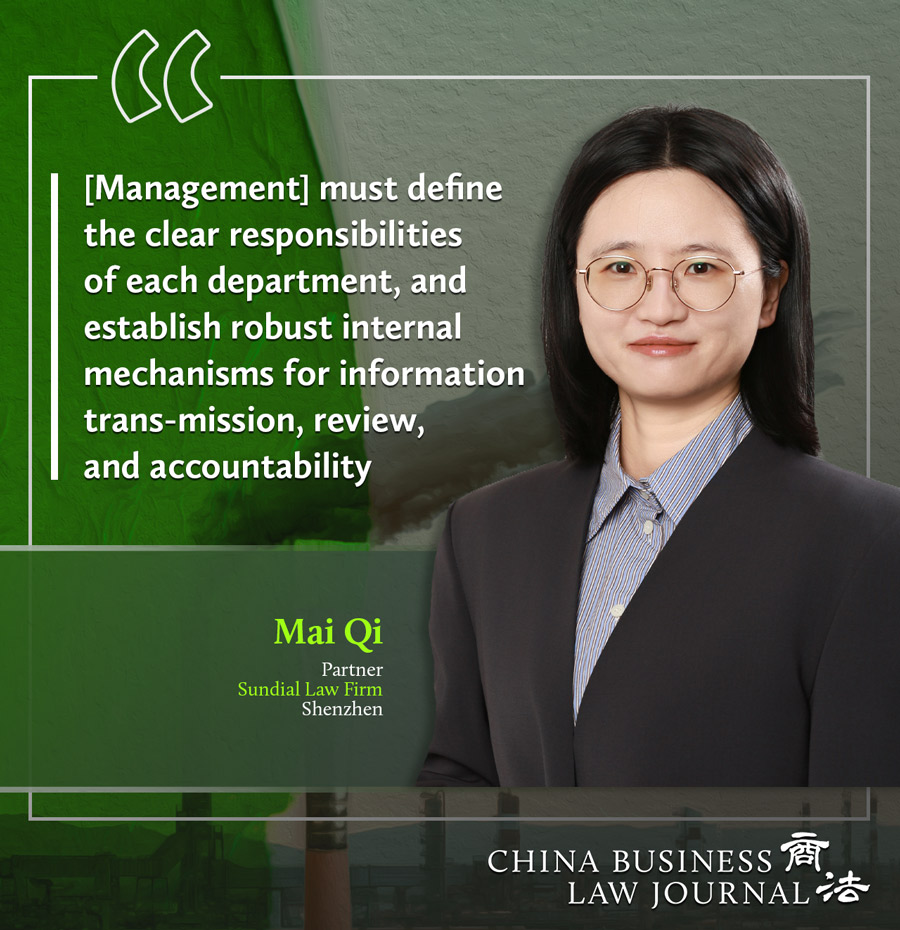
However, bringing legal to the frontlines does not mean they underwrite all factual ESG judgments. “Whoever produces the data bears the substantive responsibility for its authenticity,” says Li Ying, a Beijing-based partner at Anli Partners.
Li says that the primary responsibility for raw data on carbon emissions, labour rights and supply chain compliance must rest with the heads of the respective business lines. The internal control and audit departments should then oversee the procedural integrity of data flows, leaving the board office or ESG department to fulfil final procedural disclosure duties based on reasonable reliance.
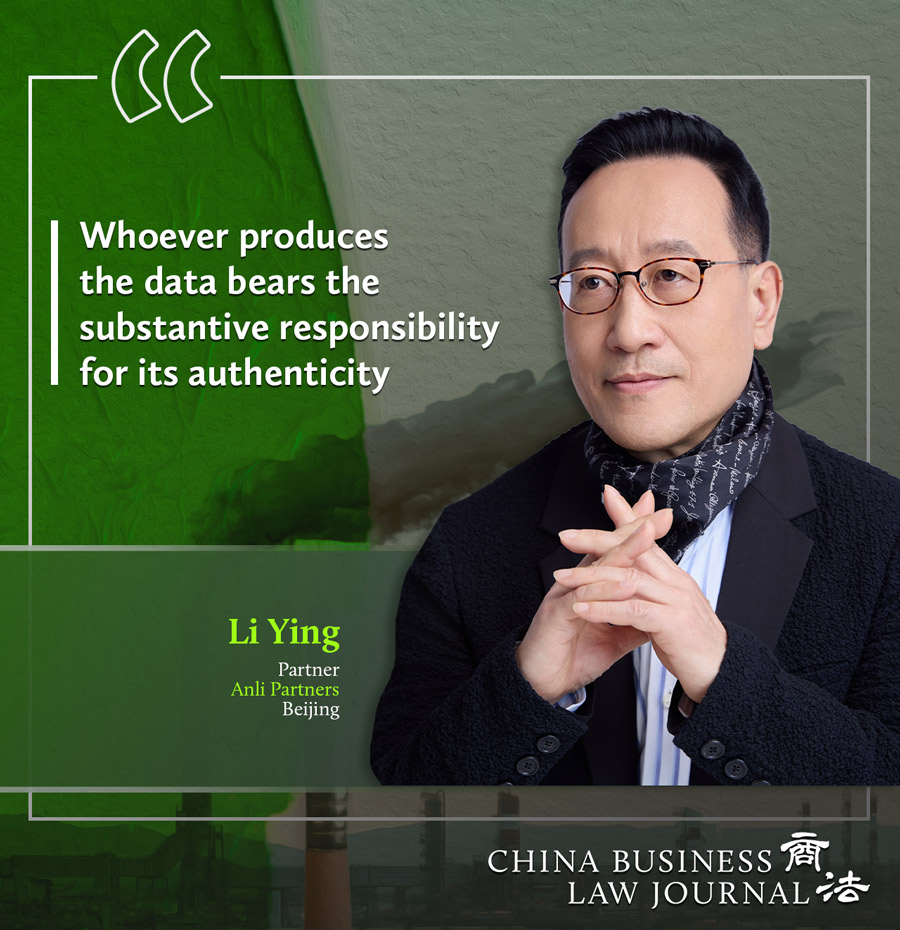
Once responsibilities are aligned, internal mechanisms must be implemented. Mai Qi, a Shenzhen-based partner at Sundial Law Firm, says management “must define the clear responsibilities of each department and establish robust internal mechanisms for information transmission, review and accountability”.
At the governance level, Zhou Wei, a Beijing-based equity partner at Zhong Lun Law Firm, says directors and senior executives, as the persons directly responsible for a listed company’s information disclosure, “have a statutory obligation to guarantee the truthfulness, accuracy, and completeness of the disclosed information.
“Directors and executives cannot simply plead ‘not being directly responsible for specific data’ or ‘lacking a professional background’ to claim exemption from liability,” says Zhou. Proving “due diligence and the absence of subjective fault” is the key.
This means that if an ESG report contains misrepresentations, individual directors, supervisors and senior executives could face civil claims from investors, and even administrative penalties.
The greenwashing bubble
When ESG reports officially enter the securities law information disclosure regulatory framework, the core risk shifts from PR problem to securities misrepresentation.
Chen Wangshu, a senior partner at Hai Run Law Firm’s Beijing office, says “the first wave of ESG misrepresentation lawsuits will likely focus on disclosures that are quantifiable, verifiable and highly relevant to investment decisions”.
This includes: greenwashing statements; distorted data on carbon emissions, energy consumption and environmental investments; inadequate disclosure of material; negative events; and misleading claims regarding ESG ratings and green financing.
Mai, of Sundial, says high-emission, energy-intensive sectors like steel and chemicals, as well as export-oriented industries such as the new energy vehicle supply chain, are highly prone to ESG controversies due to issues such as carbon intensity, resource consumption, environmental compliance, workplace safety and supply chain management.
However, Luo Kaitian, a Beijing-based partner and director of the Labour Law and ESG Practice Centre at Anli Partners, says the risk of direct, high-value civil ESG claims remains relatively limited. “The primary pressures facing companies are still regulatory investigations, reputational risks, investor pressure and settlement costs, rather than a flood of final, high-value judgments,” says Luo.
For ESG disclosure inaccuracies to be deemed securities misrepresentation liability, they must still cross a legal threshold: whether the information possesses legally recognised “materiality”.
Chen, of Hai Run, says: “If a company proactively incorporates ESG information into its periodic reports, financing documents, green bond prospectuses or investor communication channels, and such information is sufficient to influence investors’ assessments of the company’s operational risks, regulatory risks or long-term value, then the relevant content may be deemed ‘material’ and could give rise to securities misrepresentation liability.”
Yet, establishing materiality does not automatically guarantee liability. Courts must still determine a causal link between the inaccurate information, investor trading behaviour and subsequent financial losses.
Li, at Anli, says it is notoriously difficult to prove that inaccuracies in isolated ESG metrics directly trigger abnormal stock price fluctuations. The more common risk pathway, he says, is that a material ESG falsehood first provokes severe administrative penalties or forced production halts, which in turn batter the company’s fundamentals and ultimately ignite securities litigation.
In the ESG arena, where the chain of liability is longer and fraught with variables, corporate defence strategies are undergoing a fundamental pivot. Li says traditional financial fraud cases typically rely on a results-based defence, focusing on proving the authenticity of cash flows, vouchers and ledgers, alongside strict adherence to accounting standards.
Conversely, ESG misrepresentation cases demand a procedure and methodology-based defence. Companies must prove that their estimation models were sound, their data sources reliable and their judgements made in good faith, based on the information and technical capabilities available at the time.
This defence logic further bifurcates depending on the nature of the information. Zhou says that for factual, historical data, a successful defence hinges on traceable working papers, ledgers and unbroken data chains.
For forward-looking statements, however, such as net-zero targets and emission reduction plans, companies can invoke the “safe harbour” provisions of the Supreme People’s Court’s Several Provisions on the Trial of Cases of Civil Compensation for Misrepresentation Infringement in the Securities Market.
Provided the forecasts are built on reasonable grounds, accompanied by prominent risk warnings, and corrected in a timely manner, a shortfall between expectations and reality does not inherently constitute misrepresentation.
The double-edged sword of assurance
The sustainability information assurance standards, officially issued by the Ministry of Finance on 27 January 2026, have filled the institutional void for local ESG assurance standards in China, marking a shift in the nation’s ESG framework from being “disclosure-led” to focusing on “assurance-backed credibility”.
Although the implementation of the assurance standards is voluntary at this stage, their institutional evolution aligns seamlessly with the overarching strategy of the sustainability disclosure guidelines: prioritising key areas, piloting first, progressing gradually, and advancing in phases.
From a corporate perspective, when companies voluntarily commission third-party assurance, the intent is to stamp their ESG disclosures with an undeniable seal of credibility. Yet, this seal is paradoxical; it can serve as proof that management has fulfilled its due diligence obligations, or it can inadvertently widen the company’s liability exposure by signalling to the market that the information can “withstand verification”, endorsing metrics that might otherwise be questionable.
Currently, the proportion of A-share companies adopting assurance remains low. According to Sino-Securities Index (SSI) data, just 4% of A-share ESG reports in 2024 included an external assurance opinion. On the other hand, statistics from the China Industrial Bank’s Carbon Finance Research Institute reveal that, among the first batch of 427 mandatory disclosure companies in 2025, 142 had published independent assurance information, accounting for about 33%.
Behind the wait and see approach of most companies are practical factors such as costs, data foundations, and the capabilities of assurance providers. Furthermore, assurance is not a mere cosmetic overlay for an ESG report; it is a deep health check of underlying procedures that inherently carries a “double-edged” effect.
Wang Yude, chief legal officer and global general counsel at Joyson Electronics, says: “Third-party assurance can firstly significantly enhance the credibility of ESG disclosures and their recognition in capital markets, and can also force companies to establish more standardised internal data management, cross-departmental collaboration mechanisms and ESG control processes.” However, he adds that such assurance synchronously elevates a company’s legal and reputational liabilities.
From a litigation perspective, the risk profile is equally noteworthy. Li says that assured data is perceived as a commitment to a higher level of credibility, sending a signal of materiality to the market. Consequently, in the event of civil securities litigation, it could become the basis for plaintiffs to argue that the relevant information possesses materiality.
However, some lawyers offer a different assessment. “Third-party assurance is the core evidence in current judicial practice to prove that a company has fulfilled its diligence obligations,” says Zhang Xiuxiu, a Shanghai-based partner and executive director of the environmental resources and energy committee at Hui Ye Law Firm. “Assured core data can significantly reduce the probability of regulatory investigations, and even in the event of litigation it can substantially mitigate fault-based liability,” she says.
“The legal effect of assurance depends entirely on the precise delineation of assurance boundaries and the accuracy of the disclosure wording.”
Chain reaction
While the risks associated with third-party assurance are voluntarily assumed by companies, carbon emission data from the upstream and downstream supply chain is almost entirely beyond their control. These indirect emissions from suppliers and customers, known as “scope 3”, are the area where companies are least able to conduct direct verification, and they remain the most vulnerable risk point to being pierced by regulatory scrutiny and litigation.
Scope 3 disclosure is far from mature. According to an October 2025 report published by the OECD, 7,712 listed companies globally (representing 76% of total global market capitalisation) disclosed at least one category of scope 3 emissions in 2024.
In contrast, only 243 Chinese companies (representing 29% of China’s listed market capitalisation) did so, falling far below the global average and European levels (97%).
The core difficulty lies in the fact that scope 3 data is heavily reliant on external entities, making data acquisition, verification, and the delineation of liability significantly more complex.
Although scope 3 is not yet mandated under China’s domestic ESG disclosure rules, companies embedded in international value chains can no longer evade it. Wang, at Joyson, says that the Carbon Border Adjustment Mechanism (CBAM) officially took effect on 1 January 2026. Certain products from Joyson Electronics’ business divisions fall within its regulatory scope, requiring full compliance by 30 September 2027.
“However, CBAM mandates that companies trace emissions through their entire supply chain and calculate the corresponding carbon values,” says Wang. “The additional workload and costs are immense, and suppliers generally exhibit a low willingness to co-operate.
“Furthermore, continuous amendments to EU regulations make it exceedingly difficult for market practitioners and institutions to stay abreast of the evolving rules.”
Similarly, acting as a global “super supply chain anchor”, FII has embedded ESG obligations upfront into its supplier contracts. It requires suppliers to sign a Supplier Social and Environmental Responsibility Code of Conduct. Through data disclosure, on-site audits and the right of unilateral termination in the event of severe environmental or labour violations, FII integrates supply chain ESG risks into its contract management.
“Resistance during negotiations primarily stems from suppliers’ trade secret concerns regarding highly granular energy consumption data, alongside pushback from small and medium-sized suppliers over green electricity, certification costs, and breach-of-contract liabilities,” says FII’s Xie.
Meanwhile, the anonymous multinational industrial group introduced earlier in this report has adopted a tiered strategy for supplier ESG management: a mandatory disclosure plus audits approach is applied to major core suppliers, while requirements are simplified and phased in for general suppliers with smaller transaction volumes. The group’s general counsel says the biggest challenge stems from the fact that “many suppliers lack a sound accounting system for carbon emission metrics”.
Once a supplier’s fraudulent carbon data triggers litigation against a listed company, the boundaries of the “duty of reasonable care” are put to the ultimate test.
Zhou Wei says that a listed company is not automatically shielded from liability simply because the false disclosure originated from a supplier. However, “in a recovery action against the supplier, the company can adduce evidence that it had established data acquisition, verification and review mechanisms commensurate with its capabilities, imposed explicit data standards, accounting methods and submission requirements on the supplier, and conducted sample reviews and anomaly detection”.
This serves to prove that the enterprise fulfilled its duty of reasonable care, isolating the liability to the supplier. 3.png)
A+H BALANCING ACT
When presenting a single set of ESG facts, A+H dual-listed companies must simultaneously satisfy Hong Kong’s regulatory yardstick and the Chinese mainland’s compliance mandates.
Under the spotlight of dual-jurisdiction regulators, these firms are navigating a unique regulatory intersection. Article 78, paragraph 3 of the PRC Securities Law stipulates that for securities publicly issued and traded both domestically and overseas, any information disclosed by the obligor in the overseas market must be simultaneously disclosed domestically.
Rule 13.10B of the HKEX Main Board Listing Rules requires issuers to simultaneously release to the Hong Kong market any information published on other stock exchanges.
Under the constraints of simultaneous disclosure in both jurisdictions, how to co-ordinate rule differences at the operational level has become a question A+H companies must answer.
“Adopting the higher standard” is widely regarded as a more prudent approach. Zhou Wei, a Beijing-based equity partner at Zhong Lun Law Firm, says that for mandatory disclosure items, “key quantitative metrics, material risks, and governance mechanisms, companies should uniformly collect, verify and disclose information in accordance with the higher standard.
“When compiling reports under A-share and H-share rules, respectively, companies must also provide explanatory notes detailing their statistical methodologies, disclosure scopes, and the underlying reasons for any discrepancies.”
However, adopting the higher standard does not equate to a mechanical application of the strictest rules. Li Ying, a Beijing-based partner at Anli Partners, says that aiming for the highest standard requires a prudent assessment of objective jurisdictional differences and misaligned liability mechanisms.
“Ignoring discrepancies in supply chain data and statistical methodologies between jurisdictions, and rashly committing to unachievable targets, can easily trigger regulatory scrutiny due to data disconnects,” says Li.
“Furthermore, considering the rigid constraints of personal endorsement liabilities for executives in certain overseas markets, this misalignment in liability focus must be comprehensively weighed by enterprises in their decision-making.”
Facing this challenge, some leading enterprises have begun exploring systematic response mechanisms. Xie Chenyang, vice president and chief legal officer of Foxconn Industrial Internet, says that companies are constructing “a unified ‘foundational data dictionary’ that incorporates mapping matrices for multijurisdictional regulatory metrics.
“At the foundational level, data is collected at maximum granularity; at the output end, it is modularised,” says Xie. “This allows the exact same underlying data to generate distinct disclosure iterations tailored to either A-share or H-share rules.”
The essence of this mechanism is to transform the “higher standard” approach from passive compliance to proactive management, leveraging procedural controls to hedge against the disclosure risks engendered by dual-jurisdiction regulatory divergences.
UNDER THE MICROSCOPE, ON THE CLOCK
The tangible pressure of compliance often begins with a regulatory inquiry. In the inaugural reporting year, a handful of companies received inquiries from stock exchanges regarding incomplete ESG disclosures. How a company responds serves as a real-time stress test of its disclosure procedures.
Li Ying, a Beijing-based partner at Anli Partners, says adhering to a response strategy anchored in being “candid, specific and strictly scoped” entails not shying away from acknowledging technical constraints, prioritising hard data to back up claims, and strictly confining responses to the precise scope of the inquiry.
Beyond damage control, companies must focus on pre-emptive defence. Xie Chenyang, vice president and chief legal officer of Foxconn Industrial Internet, advocates for establishing a time-stamped data archive to ensure that “when questioned, the underlying working papers can be retrieved within an hour”.
Chen Wangshu, a Beijing-based senior partner at Hai Run Law Firm, says that if a company fails to implement adequate rectifications post-inquiry or provides contradictory responses, the inquiry letters, subsequent responses and remediation records could ultimately be weaponised as evidence of its subjective fault in future misrepresentation disputes.
For companies not yet swept into the mandatory disclosure net, the clock is ticking. The China Securities Regulatory Commission has signalled its intent to explore expanding the roster of entities subject to mandatory disclosure.
Zhang Xiuxiu, a Shanghai-based partner and executive director of the environmental resources and energy committee at Hui Ye Law Firm, says indices such as the Shanghai Stock Exchange 180 Index are rebalanced semi-annually.
“A company could suddenly find itself added to an index, triggering an urgent mandate to produce its inaugural ESG report within a tight six-month timeframe,” says Zhang.
“Even absent mandatory ESG reporting, environmental compliance and material penalties are already statutory disclosure requirements within annual reports; thus, adverse ESG events can still precipitate regulatory inquiries.”
Facing this uncertain pace of expansion, lawyers highlight a consensus preparatory measure: embedding legal teeth directly into supply chain contracts. Companies are inserting “ESG data authenticity warranties” and “breach-of-contract indemnification clauses” into supplier agreements.
Should fraudulent upstream reporting trigger regulatory sanctions or greenwashing litigation, the anchor company is then armed with a definitive legal basis for recourse. Deployed in tandem with this legal defence line are two foundational procedural compliance measures, according to Luo Kaitian, a Beijing-based partner and director of the Labour Law and ESG Practice Centre at Anli Partners.
The first is migrating historically chaotic manual logs of “energy consumption, workplace injuries and hazardous waste” into digital ledgers with clearly delineated accountability. The second is recalibrating and isolating the most financially material ESG issues tailored to specific industry characteristics.
Within this framework, Luo says that the “S” (social) dimension, such as labour rights, suffers from fragmented metrics and a lack of quantifiability and verifiability. Even if these metrics are not slated for immediate disclosure, companies must begin aggregating the underlying baseline data in advance.
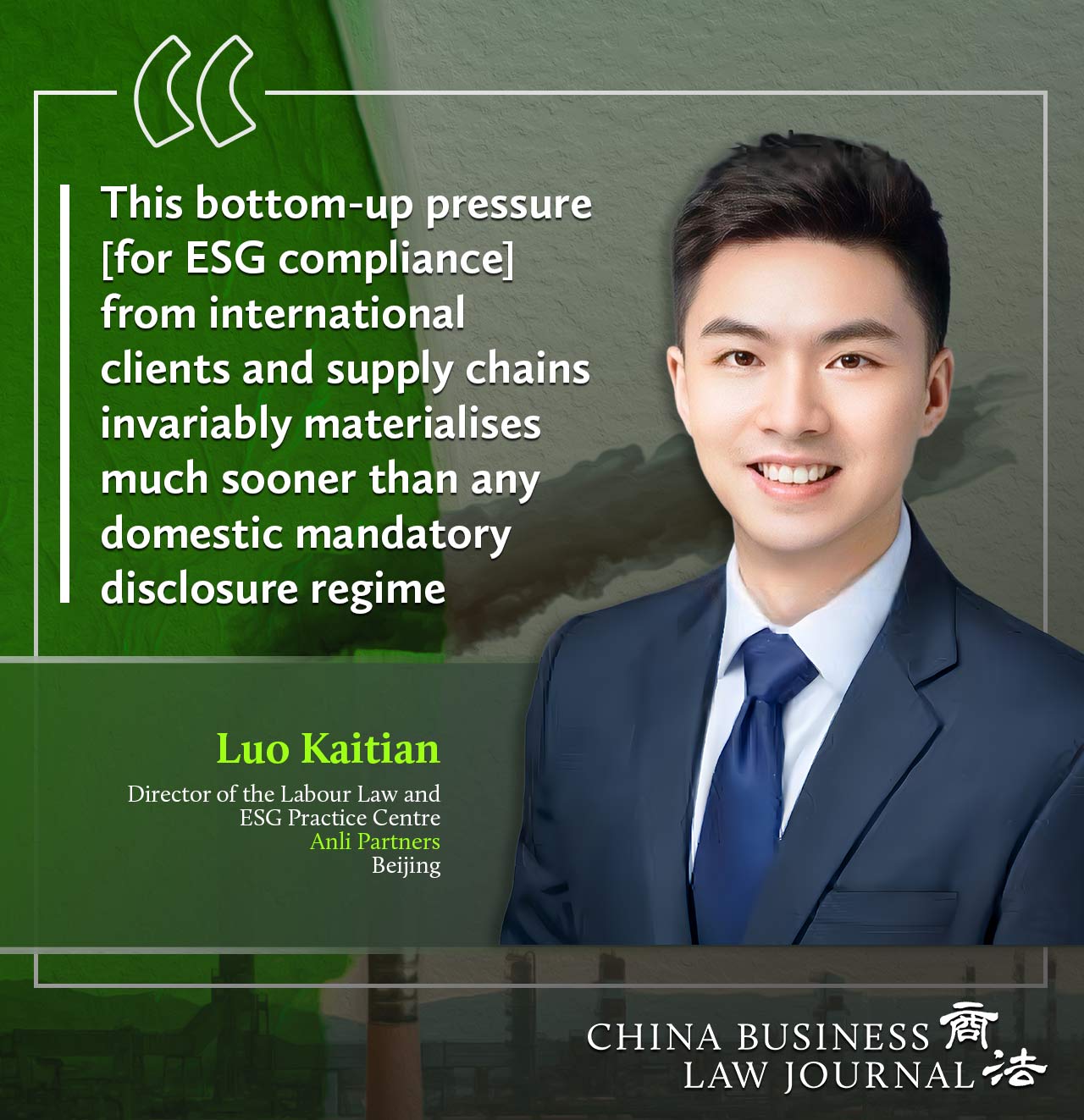
Luo also says that companies must not underestimate the immediate, practical pressures of being required to furnish ESG documentation on demand during multinational client tenders, supply chain due diligence or vendor onboarding processes. “This bottom-up pressure from international clients and supply chains invariably materialises much sooner than any domestic mandatory disclosure regime.”