









Senior law firm partners must part ways with their firms if they covet the honour of practising as senior advocates. Manokamana asks leading lawyers whether it is time for this rule to change
Being designated a senior advocate is one of the highest honours in Indian legal practice, an honour representing recognition by the Supreme Court or High Court that a lawyer is sufficiently knowledgeable to merit valuable participation in modern jurisprudence.
Similar to the UK’s king’s counsel (KC), known as “silks”, or Singapore’s senior counsel (SC), the designation sets them apart, recognising their expertise and achievements.
Section 16 of the Advocates Act, 1961 lists criteria for designation of the counsel’s professional excellence and standing at the bar of the court, or special knowledge or experience in law.
But like every advocate in the profession, senior advocates are also subject to Bar Council of India (BCI) rules, and the rules restrict designated senior advocates from filing their own vakalatnama (documents of representation), or pleadings, or from accepting briefs directly from clients. The restrictions also talk about advisory roles, drafting and filing appearances before a court or tribunal, among other conditions and guidelines.
These restrictions effectively mean becoming a completely independent practitioner when receiving the designation.
In recent times, India Business Law Journal has observed that several senior partners at law firms have left their firms before or after receiving the title.
Rajeshwari Hariharan stepped down as the managing partner of Rajeshwari & Associates before being appointed senior advocate to Delhi High Court.
David Robin Ratnakar also received the senior designation this year, having stepped away from his role as partner at Dua Associates in 2023. Gyanendra Kumar was designated senior advocate by Delhi High Court while still a partner at Cyril Amarchand Mangaldas and left the firm in 2025 to comply with the rules.
Wind of change
But is change afoot? The Society of Indian Law Firms (SILF) seeks to bring about change so that partners do not need to depart from their firms. SILF is a prominent advocacy organisation of top corporate law firms in India, with many eminent personalities from various law firms as active members.
Lalit Bhasin, the president of SILF, says the organisation is working with the BCI to bring an amendment to the rules in this regard. “SILF has during the past few years taken up this issue with the Bar Council of India and has been pursuing it vigorously,” he says.

IBLJ talked to some of the lawyers who have left their firms and hope to seek the designation in future. In their words, the choice is between passion and the structure of the firm – and most choose to follow their passion.
Many former law firm partners who went independent say seeking senior advocate designation was a major reason behind their decision to leave, inspired largely by both deep appreciation for the craft of the profession and the desire to experience autonomy.
Kunal Vajani went independent with Chambers of Kunal Vajani in Delhi after serving as the joint managing partner of Fox & Mandal. “I have long harboured a deep and abiding passion for advocacy [and] I have found that it suits both my temperament and my ambitions rather better than I had dared to anticipate,” he says.
PVS Giridhar, senior advocate, Madras High Court in Chennai, feels similarly. He was a senior partner at his own firm for 20 years before he went independent. With more than 30 years in the profession, Giridhar has been “really enjoying being independent” as it allows him to focus on work and research without the burden of procedural and administrative tasks.
Swathi Sukumar, senior advocate, Delhi High Court, also made the shift. “I enjoy arguing matters and wanted autonomy in choosing my cases and clients,” she says. Sukumar was part of the team at Anand and Anand for four years earlier in her career, before choosing to make the switch.
The transition from senior partnership at the firm to his own practice as a designated senior advocate was smooth for Zarir Bharucha, designated by Bombay High Court in Mumbai. Bharucha was a partner at Zarir Bharucha and Associates in Mumbai for 27 years before being designated in 2024. “Segueing into counsel practice was natural for me as I did a lot of advocacy even when in partnership, and had been arguing cases for a long time,” he says.
For Vyapak Desai, it was about timing. He was a part of the team at Nishith Desai Associates for 20 years before going solo and establishing Vyapak Desai Law Chambers in Mumbai. “I strongly believe it was the right time to capitalise on the 25 years of experience as part of a law firm, and to now invest time and effort in focusing on just arguing counsel practice to achieve desired objectives before courts and tribunals,” he says.
The experience of a long journey at a law firm and then switching to independent practice is shared by Satvik Varma, senior advocate, Delhi High Court. “I had to get back to my first love, which is to be a litigator,” he says. Varma was previously a partner at the erstwhile Amarchand Mangaldas.
Bringing the best of both worlds is a common undertone of the shift from law firm career to independent practice. According to Bhasin, this advantage will get a further boost if sitting law firm partners are allowed to remain affiliated with their firms, even after receiving the designation.
“Litigation arising out of corporate disputes need considerable expertise and specialisation, and no one is better equipped than the managing and senior partners of law firms to appear and present the case on behalf of their clients as senior advocates,” he says.
These changes are much needed, according to many of the professionals who spoke to IBLJ. In their opinions, the existing rules and restrictions may be outdated for modern legal practice in India.
Catching up with time
“The designation evolved at a time when legal practice revolved almost entirely around courts,” says Indranil Deshmukh, partner (head of disputes) at Cyril Amarchand Mangaldas in Mumbai. “Judges personally observed advocates in action [and] could invite deserving lawyers to the senior bar based on first-hand knowledge.

“That world no longer exists. Today, the process requires a formal application. Judges cannot know every applicant personally. The framework has not kept up with how much the profession has evolved.”
Deshmukh also highlights a major modern shift – the significance of written advocacy in modern disputes. Written submissions, pleadings, briefs and arguments filed before a tribunal or arbitration panel “carry tremendous weight in modern proceedings,” he says. This may largely be because of the modern shift towards online dispute resolution, where in-person presence and presentation is limited.
Mamta Rani Jha, co-managing partner at Inttl Advocare in Delhi says: “When the criteria were introduced over six decades ago, litigation-oriented law firms were far less prevalent in India than they are today.
“Today, several law firm partners in India regularly appear before constitutional courts and argue complex commercial and arbitration matters”, displaying the attributes required of a practitioner to receive the designation.
Raj R Panchmatia, disputes partner at Khaitan & Co in Mumbai, says: “In today’s legal market, a significant amount of high-value, complex disputes cuts across law firms, particularly in commercial litigation, arbitration and cross-border disputes.”
Aruneshwar Gupta, senior advocate, Supreme Court of India in Delhi, calls specialised law firms an integral functional part of the contemporary legal ecosystem. He says firms are now building themselves as experts in specific practice areas and providing end-to-end services for their niche practice, including appearing before courts.
On the other hand, Sukumar believes the designation framework is not the only one that needs to evolve. Law firms have their own evolving to do.
“An underlying question is whether highly qualified advocates within firms are being encouraged to argue matters and pursue the counsel track,” says Sukumar. “The question is whether firms offer space for counsel practice. If the answer is no, then the model within law firms may need to be revisited.”
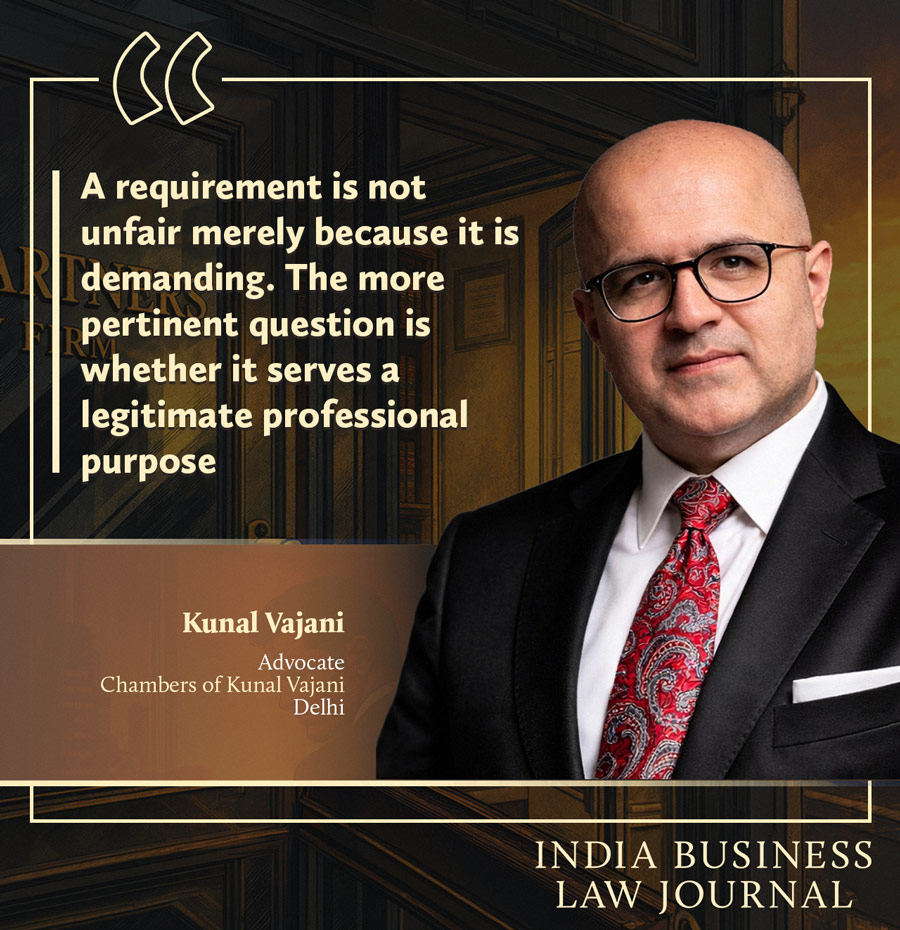
Vajani agrees, saying the restrictions a senior advocate is subject to – namely, prohibition from receiving briefs from clients directly; the requirement to be instructed through another lawyer; and the bar from drawing up pleadings and performing the work of a solicitor – are all “structurally incompatible with the day-to-day functioning of a law firm partner”.
So, it appears changes may need to be made by law firms as well. Sukumar suggests flexible revenue models, arguing opportunities and independent outside firm collaborations are some of the possible changes for firms to provide a fair chance for existing partners to work actively towards senior advocate designation.
Law firms are not unwilling to change, and many are happy to be subject to restrictions designed for sitting partners who may be designated as senior advocates so that they do not have to leave the firm.
Bhasin is welcoming any restrictions the BCI may place on senior advocates who remain part of firms as partners, as long as their expertise is recognised and acknowledged as it should be. “There are outstanding managing and senior partners who regularly appear in courts without engaging senior counsel,” he says.
“Their status is no less than that of a designated senior advocate. Accordingly, it would be appropriate if [they] are designated, subject to the regulations that may be put by the BCI.”
Championing the cause
There is also an active call in the wider legal fraternity to amend the rules so that sitting law firm partners do not have to leave their firm once they receive the senior advocate designation. In 2021, the Indian Arbitration Forum, an association of arbitration practitioners in India, wrote to the then chief justice of India, NV Ramana, presenting their views on the discussion.
Gupta welcomes this idea. “A sitting partner of a law firm should not be compelled to sever their professional association with the firm merely for designation as a senior advocate.”
According to Panchmatia: “The reform should be seen as a positive step. Sitting law firm partners who are deserving should not be excluded merely because they practise within a firm structure.”
The loss is not just limited to partners at the firm, forced to choose between one or the other. Jha believes the restrictions also keep proficient experts from assisting the court in the best possible manner, simply because they are not designated senior advocates, even if prima facie they have the required attributes.
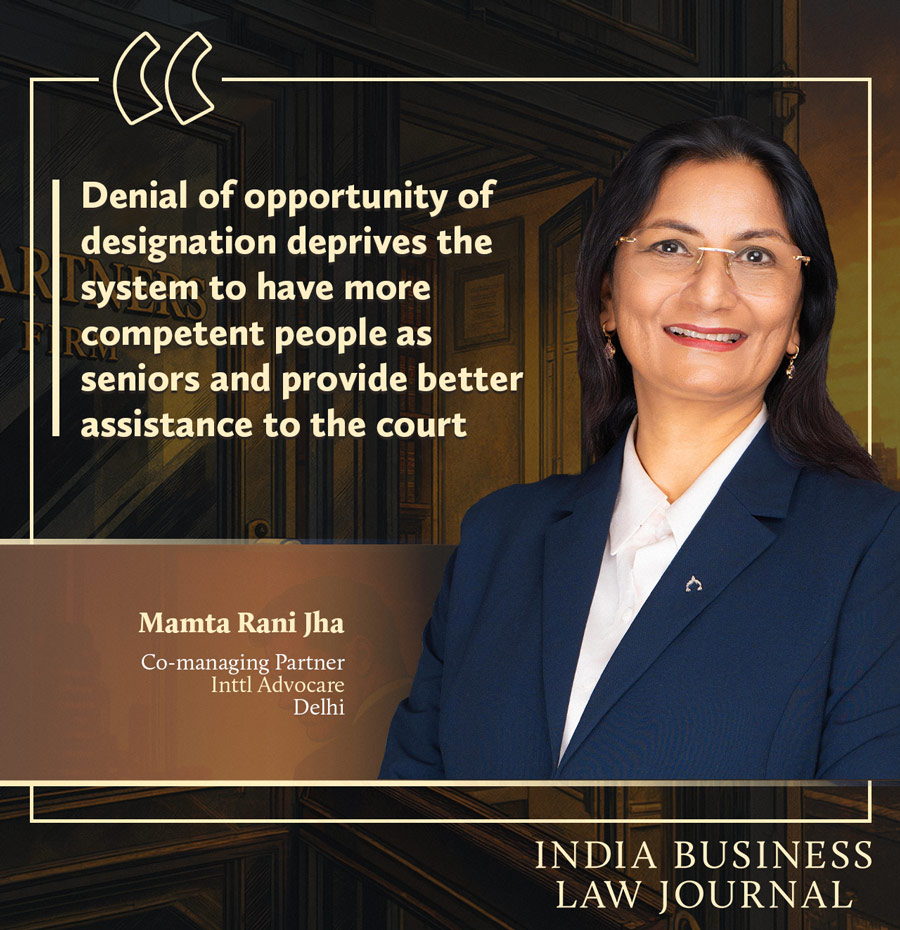
“Denial of opportunity of designation deprives the system to have more competent people as seniors and provide better assistance to the court,” she says.
This does not mean, however, that partners who exit law firms do so solely to focus on achieving the designation. Some do it out of pure love for the profession.
Many benefits
A senior advocate well versed in the case, but also has existing smooth teamwork with supporting lawyers may sound like a lucky coincidence. But this is what lawyers say is possible if the rules were to be amended.
According to Deshmukh, the benefits are obvious – confidentiality, better co-ordination and predictable costs for clients.
But cost may just be one of the more significant advantages. “It will be very cost effective if managing [and senior] partners are designated as senior advocates, since there would be no need to engage another senior advocate, as per the current practice,” says Bhasin.
Bharucha says the idea brings forward the best possible combination. “A good counsel is one who has the nous of the court, and is able to get a commercial and practical result for the client,” he says. “The ideal position is where counsel can both present arguments in a manner appealing to the court while ensuring that the client’s commercial viewpoint is well articulated.”
Deshmukh says such an amendment would elevate the sophistication of Indian practice globally, where Indian counsel are up against the Singaporean or UK-equivalent professionals of similar recognition as senior advocates. Globally, clients prefer a seamless and integrated model of practice.
“[But currently] Indian firms have to present a fragmented approach,” he says. “Law firms may develop the case strategy, prepare briefs and manage the matter from start to finish, but in case the client wants a senior advocate for oral advocacy, an external senior advocate must then be engaged.
“This structural separation places Indian law firms at a competitive disadvantage in international matters.”
The concerns
Despite the benefits, the possibility of sitting law firm partners being designated as senior advocates without having to leave their firms is not without its concerns.
“The real issue is not partnership per se, but professional accountability in court proceedings,” says Gupta. Some restrictions must be placed on any sitting law firm partner designated as a senior advocate.
“The restriction relating to signing of vakalatnama may continue to apply, even while permitting them to remain associated with the law firm,” he says. “The advocates who actually file and sign the vakalatnama should alone remain directly responsible and liable for procedural compliance, professional conduct, and any misconduct arising.”
Vajani adds: “Any overlap with the transactional, advisory or client-facing functions of a law firm partner does not merely create a conflict of interest in the conventional sense. It actively hampers the discharge of that duty, diverting attention, loyalty and bandwidth from the court to the commercial.”
According to Sukumar, if the rules were amended, the concern around required independence would be difficult to navigate. “One of the central traits of a senior advocate is independence from the client, and the freedom and ability to act as an officer of the court in a dispassionate way,” she says.
“On the other hand, a law firm partner has a vital responsibility to focus on raising revenue and visibility for the firm, and providing service to the firm’s clients. These two goals can be challenging to reconcile.”
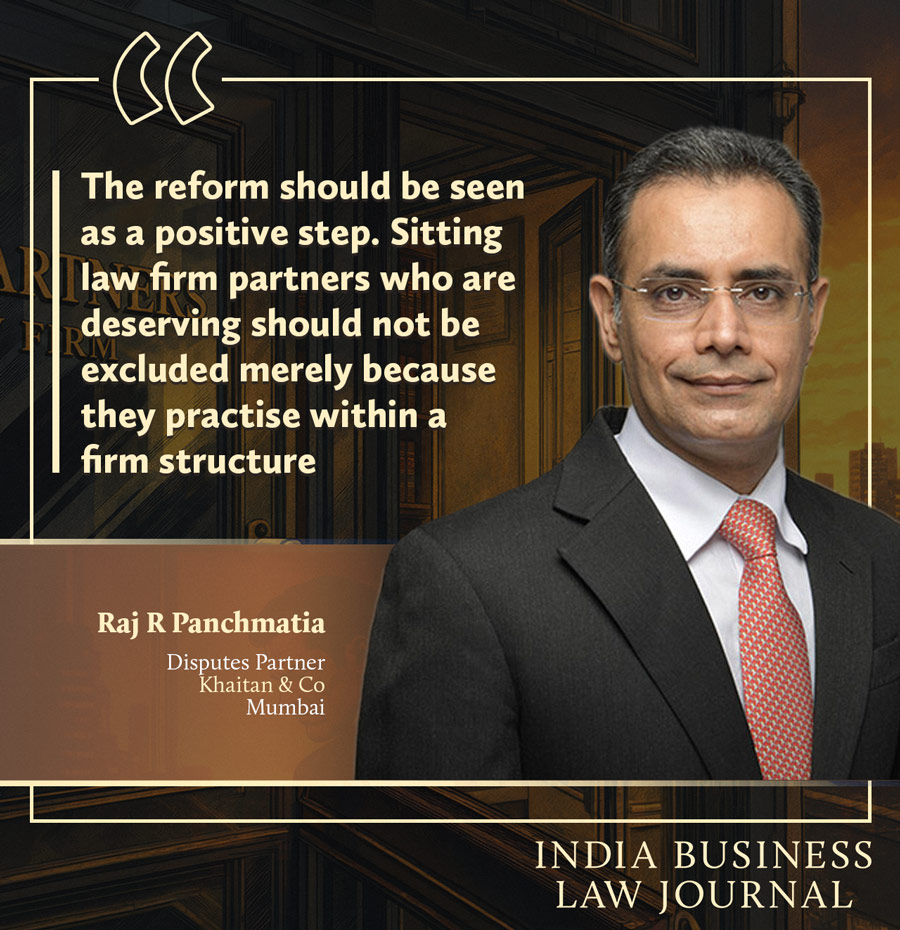
Panchmatia is confident in the law firm structure being able to adapt to the new requirements. “The changes required are largely manageable with timely deliberations and bringing together all stakeholders,” he says.
To enable the smooth adoption of changes by law firms, Deshmukh suggests: “there should be a clear separation between the senior advocate function and other practices of the firm”.
Another major challenge, according to Bhasin, is not change itself, but the cultural understanding of the fraternity at large: “The main challenge is to change the mindset of the regulator and the government.”
Vajani says: “Altering the generations-old understanding of the legal profession through rule amendment alone, without the corresponding shift in professional culture and expectation, risks creating a designation that is formally expanded but substantively diminished, a bargain that serves no constituency well.”
Giridhar is also apprehensive of the amendment. “It risks creating commercial advantages for larger firms that can market themselves around designated senior advocates.”
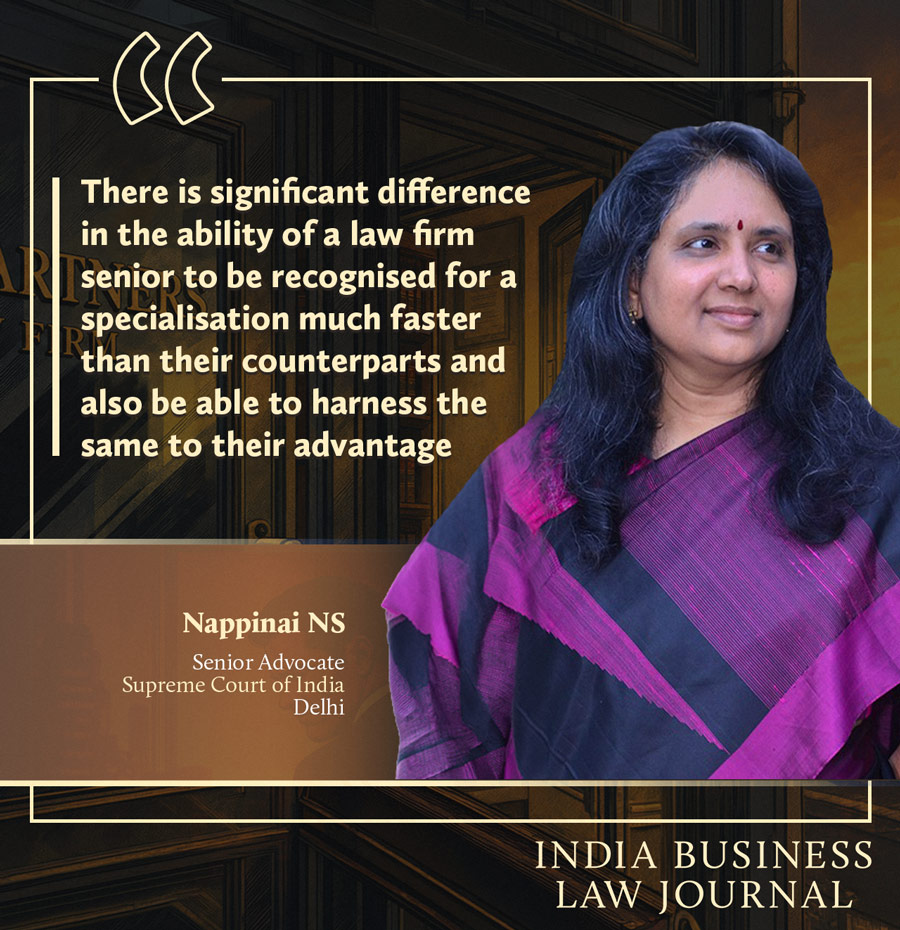
Nappinai NS, senior advocate, Supreme Court of India in Delhi, explains: “There is significant difference in the ability of a law firm senior to be recognised for a specialisation much faster than their counterparts and also be able to harness the same to their advantage. The volume of work, quality and size vary, which may give a substantial advantage specifically qua visibility for a law firm partner.”
According to Varma, it is about making a choice. “The profession is very welcoming, but at some stage it is important to make career choices, and in those career choices, some will come with a trade-off,” he says.
Vajani concludes: “A requirement is not unfair merely because it is demanding. The more pertinent question is whether it serves a legitimate professional purpose, and in this instance I believe it unambiguously does.
“The willingness to make the transition is itself, in some measure, a test of the seriousness of the aspiration.”